Veterinarians diagnose pancreatitis in dogs by putting several pieces together: your dog's history, a physical exam, a pancreatic lipase blood test (often called Spec cPL), bloodwork, and imaging, usually an abdominal ultrasound. No single test is enough on its own. The Merck Veterinary Manual says plainly that diagnosis should combine clinical findings, imaging and serum pancreatic lipase results rather than rely on any one of them.
That matters for you as an owner. A dog who is vomiting, hunched and refusing food needs to be seen promptly, and the visit will probably involve more than one step. This guide explains what each step is, what it can and cannot tell us, and how to prepare so the process is faster and calmer for both of you.
TL;DR
- Pancreatitis is diagnosed by combining history, a physical exam, a pancreatic lipase test (such as Spec cPL), bloodwork and imaging. No test should be used alone.
- Vomiting, diarrhea, lethargy, loss of appetite, abdominal pain and a hunched posture are the common signs. Several together mean a vet visit as soon as possible.
- A negative in-clinic lipase screen makes pancreatitis very unlikely. A positive one is normally followed by a quantitative test.
- Ultrasound is the imaging of choice, but its accuracy depends on the operator, the timing and how severe the disease is.
- We run Fear Free visits and offer home visits, so a sick or anxious dog can be examined with less stress.
Table of Contents
- Signs that should send you to the vet
- Step one: history and physical exam
- The pancreatic lipase test (Spec cPL and similar)
- Bloodwork: a wide net, not a verdict
- Imaging: X-rays and ultrasound
- Why there is no single gold-standard test
- What the visit looks like with a nervous or sick dog
- Our perspective: diagnosis works best when it is calm, complete and close to home
- Book a diagnostic visit in Brooklyn
- After the diagnosis: what comes next
- FAQ
- Sources
Signs that should send you to the vet
The signs of pancreatitis overlap with many other digestive problems, which is exactly why testing is needed. According to the American Kennel Club, common symptoms include:
- Vomiting
- Diarrhea
- Lethargy
- Loss of appetite
- Abdominal pain
- Dehydration
- A hunched back
A dog with several of these should see a veterinarian as soon as possible. The same source lists dry gums, worsening lethargy, refusing to drink, or being unable to keep water down as reasons for immediate care.
A few practical notes from the exam room:
- The hunched posture is easy to miss. Some dogs stand with the front end lowered and the rear raised, or refuse to lie flat. Tell us if you saw it, even briefly.
- Pain can look like "just tired." A dog who suddenly won't play, won't eat a favorite treat or hides under the bed is communicating something.
- Water matters as much as food. If your dog vomits after drinking, do not wait to see whether it passes.
If you are unsure whether this is an emergency, our guide to five red flags that need an emergency vet walks through the decision. For a vomiting dog specifically, see when to rush in or request a low-stress home visit. If your dog has collapsed, has pale gums, or is repeatedly vomiting and cannot stand, go to an emergency hospital right away.
Step one: history and physical exam
The diagnosis starts before any test. The veterinarian asks what your dog has eaten recently, when the vomiting began, how often it happens, whether there has been diarrhea, and whether your dog has had similar episodes. Details such as table scraps, a raided trash can, new treats or a change in routine help point toward or away from the pancreas.
Then comes the physical exam. We check hydration, gum color, temperature, heart rate, and gently feel the abdomen for pain. A dog who tenses or turns to look at the belly when it is touched gives useful information. None of this proves pancreatitis, but it shapes which tests come next and how urgent they are.
Helpful things to bring or note before you arrive:
- A timeline of symptoms, with times if you can recall them.
- Everything your dog may have eaten in the past several days, including fatty foods, bones and anything from the garbage.
- Current medications and supplements, with doses.
- A photo or video of any vomit or unusual posture.
- Records from any previous vet, especially earlier lab results.
The pancreatic lipase test (Spec cPL and similar)
The blood test most owners hear about is the Spec cPL. It measures pancreatic lipase immunoreactivity, or PLI, a marker tied to the pancreas. The Merck Veterinary Manual describes PLI measurement as specific for serum pancreatic lipase concentration and the most specific diagnostic test for pancreatitis.
In-clinic screening versus the quantitative test
There are two versions of the idea. A rapid, in-clinic semiquantitative test gives a quick answer while your dog is still with us. According to the same Merck manual entry, a negative result suggests pancreatitis is very unlikely, while a positive result suggests pancreatitis and should be followed by a quantitative assay to confirm it and set a baseline.
In plain terms:
- Negative rapid test: we start looking for other causes of the vomiting and pain.
- Positive rapid test: we confirm with the quantitative value and read it alongside the exam and imaging.
If your dog's report shows a number in the gray zone, our article on what a 201 to 399 μg/L cPL result means explains how we think through it with owners.
Why a lipase result is never read alone
Two cautions are worth knowing. First, lipase tests do not perform equally in every dog. An academic review in the Journal of the American Veterinary Medical Association notes that severe pancreatitis is associated with higher diagnostic sensitivity, while mild cases are associated with lower sensitivity. So a dog with a mild episode may be harder to catch on a single number.
Second, false positives happen. A Today's Veterinary Practice article points out that false-positive pancreatic lipase results, especially from cage-side assays, are possible in dogs with abdominal disease. A dog with an intestinal problem, for example, can have an abnormal result without pancreatitis being the main issue.
The review also explains that newer lipase assays based on a substrate called DGGR were introduced as more specific than older methods, though their analytical specificity can vary. If you have seen different lipase tests mentioned online or on a lab report, this is why the name of the test matters and why we interpret the result in context.

Bloodwork: a wide net, not a verdict
A complete blood count and chemistry panel are part of nearly every sick-dog workup. They do not diagnose pancreatitis by themselves. According to the Merck Veterinary Manual, routine bloodwork is nonspecific, but it can reflect systemic complications or concurrent conditions and help rule out other explanations.
What bloodwork helps us answer:
- Is your dog dehydrated, and how badly?
- Are the kidneys and liver coping?
- Is there evidence of inflammation or infection?
- Could another disease be causing the same symptoms?
Because we have an in-house laboratory, many of these results can be back while your dog is still in the building, which lets us start supportive care sooner. If you want to understand what a panel looks at, see our overview of what goes into dog blood work. Related tests, such as urinalysis and fecal testing, are often added when diarrhea or other signs point that way. Giardia, for instance, can mimic digestive upset, which is covered in our guide to Giardia in dogs.
Imaging: X-rays and ultrasound
Abdominal X-rays
Radiographs sound like the obvious first picture, yet the pancreas itself does not show well on them. The Merck manual states that abdominal radiographs are nonspecific for pancreatitis but valuable for excluding other differential diagnoses. In practice, that means X-rays help us rule out a swallowed object, an obstruction or another cause of vomiting that would need a very different treatment.
Abdominal ultrasound
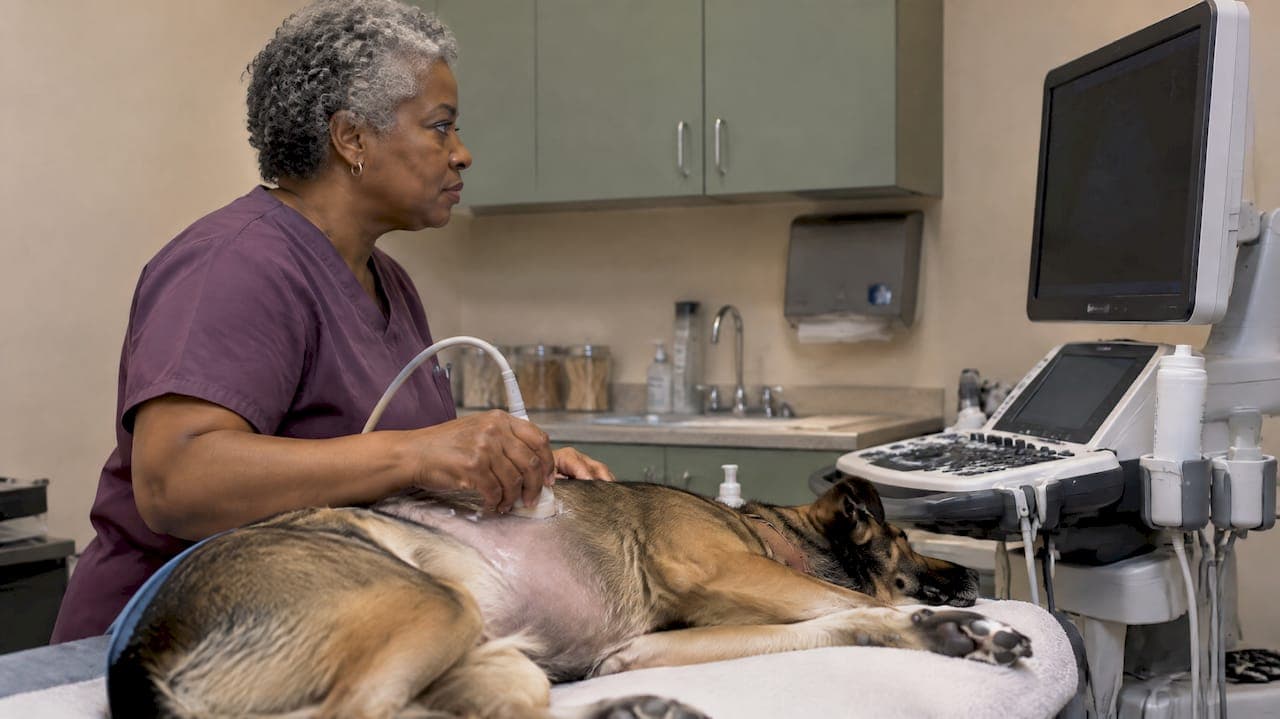
Ultrasound is where we see the pancreas and the tissue around it. Today's Veterinary Practice calls abdominal ultrasonography the imaging modality of choice, with findings that can include an enlarged, hypoechoic (darker) pancreas surrounded by bright, hyperechoic mesentery. The Merck manual adds that ultrasound can show pancreatic enlargement, fluid around the organ, changes in echogenicity or a mass effect, and is especially supportive in severe acute cases.
The limits are real, and we want you to hear them from us:
- Sensitivity is highly operator-dependent.
- Success also depends on disease severity, timing, equipment, and the ultrasonographer's experience and level of suspicion.
- Findings should not be over-interpreted, because a pancreas that looks unusual is not always the cause of the illness.
A normal-looking ultrasound therefore does not completely close the door when the other findings point to pancreatitis, and a suspicious one is weighed against the blood tests and exam. Our diagnostic imaging service includes digital X-rays and ultrasound, so the images and the lab work can be considered together by the same team.
Why there is no single gold-standard test
Owners sometimes ask for "the definitive test." The honest answer is that one does not exist in everyday practice. A 2021 academic review on diagnosing acute pancreatitis in dogs notes that the lack of a universally accepted gold standard hampers diagnosis. Many clinicians use a clinical reference standard that integrates several modalities, which may select for more severe cases.
Tissue examination of the pancreas under the microscope is considered the reference in principle, but it requires surgery or a biopsy, and that is rarely appropriate for a sick dog just to confirm a diagnosis. So veterinarians rely on the combination approach:
| Piece of evidence | What it adds | Main limitation |
|---|---|---|
| History and exam | Pattern of signs, abdominal pain, hydration status | Signs overlap with many other diseases |
| Pancreatic lipase test (Spec cPL or similar) | The most specific blood marker for the pancreas | Lower sensitivity in mild cases; false positives possible with abdominal disease |
| Routine bloodwork | Organ function, dehydration, concurrent disease | Nonspecific for pancreatitis |
| Abdominal X-rays | Rules out obstruction and other causes | The pancreas is not shown well |
| Abdominal ultrasound | Direct look at the pancreas and surrounding tissue | Depends on operator, timing and severity |
When several rows point the same way, confidence rises. When they disagree, we say so, and we may repeat a test or recheck your dog rather than force a conclusion.
What the visit looks like with a nervous or sick dog
A dog in pain is often a frightened dog, and stress can make an exam harder and less informative. We are Fear Free certified, and that shapes the way testing happens: calmer handling, slower approaches, treats when appropriate, and minimizing the time your dog spends restrained. Owners often tell us that this changes how willing their dog is to come back for rechecks, and rechecks are a normal part of managing pancreatitis.
A typical diagnostic visit often follows this order:
- We talk through the history and take your dog's temperature, heart rate and hydration status.
- We examine the abdomen gently.
- We draw blood for the chemistry panel, blood count and lipase testing.
- Depending on the findings, we add X-rays or ultrasound.
- We discuss what we know, what we do not know yet, and what happens next, including whether your dog needs hospital-level care.
If getting your dog into a carrier and across Brooklyn feels like too much, our home visit service lets us start with an exam in your living room. Some dogs are too unwell for that to be enough, and we will tell you honestly if hospital care or more advanced testing is the safer route.
Our perspective: diagnosis works best when it is calm, complete and close to home
We see pancreatitis worries from two directions. Some owners wait because the signs look like a simple upset stomach. Others arrive with a dog who is shaking from fear on top of feeling terrible. In both cases, our goal is the same: reach a clear, well-supported answer without adding stress that makes the picture harder to read.
We believe in the combined approach described above because it matches how the condition behaves. A single lipase number can mislead, a single ultrasound can be inconclusive, and a dog who is panicking can mask or mimic abdominal pain. That is why we pair Fear Free handling with in-house testing and diagnostic imaging under one roof, so the history, bloodwork and images are interpreted together by people who know your dog.
We also think follow-up matters as much as the first visit. Pancreatitis often needs thoughtful nutrition afterward, and our team can help with nutritional counseling and long-term planning. Our holistic options, such as acupuncture and pain management, sit alongside conventional care when they suit a particular patient, never in place of the diagnosis.
— CAVC
Book a diagnostic visit in Brooklyn
If your dog is vomiting, off food or hunched and uncomfortable, we can examine your dog, run lab work in-house and use digital X-rays and ultrasound as needed, all with a Fear Free approach. If travel is the obstacle, ask about a house call. New clients can start on our new client page, and urgent concerns can go through our urgent care service.

You can also reach us through City Animal Veterinary Center to ask which tests are right for your dog's situation.
After the diagnosis: what comes next
Once pancreatitis is likely or confirmed, the plan is built around how sick your dog is. Treatment depends on severity, and your veterinarian will tailor it. What owners can do at home is usually about nutrition and watching for relapse. Our article on diet, fat targets and recovery for dogs with pancreatitis covers feeding in detail.
Two habits help after any episode:
- Keep the records. Your dog's baseline lipase value, imaging reports and bloodwork make later comparisons far more useful. The Merck manual recommends following a positive screen with a quantitative assay to set a baseline.
- Tell us about any new vomiting, appetite change or belly discomfort early. A recheck is easier than a crisis.
Regular wellness exams are where we catch weight gain, dietary issues and subtle changes before they become emergencies.
FAQ
Can a vet diagnose pancreatitis with just one test?
No. Veterinary references advise against using any single test in isolation. Diagnosis combines your dog's history, the physical exam, a pancreatic lipase test and imaging. When the pieces agree, we can be confident. When they do not, we recheck or investigate further.
What is the Spec cPL test, and does a normal result rule pancreatitis out?
Spec cPL measures pancreatic lipase immunoreactivity, a marker linked to the pancreas. A negative in-clinic screening result makes pancreatitis very unlikely, and a positive one should be followed by a quantitative test. Because mild cases can be harder to detect, we still read any result alongside the exam and imaging.
Is an ultrasound necessary for diagnosing pancreatitis?
Ultrasound is considered the imaging method of choice, and it also helps find complications or other causes of belly pain. Its accuracy depends on severity, timing and the skill of the person scanning. We use it together with lab work rather than as a stand-alone answer.
Why are X-rays done if they don't show pancreatitis well?
Radiographs are useful for ruling out other problems, such as an obstruction or foreign object, that can look like pancreatitis. Excluding those causes keeps treatment on the right track. The pancreas itself is better evaluated with ultrasound and blood tests.
Should I wait to see if my dog's vomiting passes?
Not if there are several symptoms together, or if your dog has dry gums, worsening lethargy, will not drink or cannot keep water down. Those call for immediate veterinary care according to the AKC. For milder, single episodes, our guide on when to see a vet and when to wait can help you decide.
Sources
- Pancreatitis in Dogs: Signs, Symptoms, Treatment (American Kennel Club)
- Pancreatitis in Dogs and Cats (Merck Veterinary Manual)
- Understanding lipase assays in the diagnosis of pancreatitis (JAVMA)
- Top Questions From General Practitioners About Pancreatitis in Dogs (Today's Veterinary Practice)
- Advances in the diagnosis of acute pancreatitis in dogs (PubMed Central)