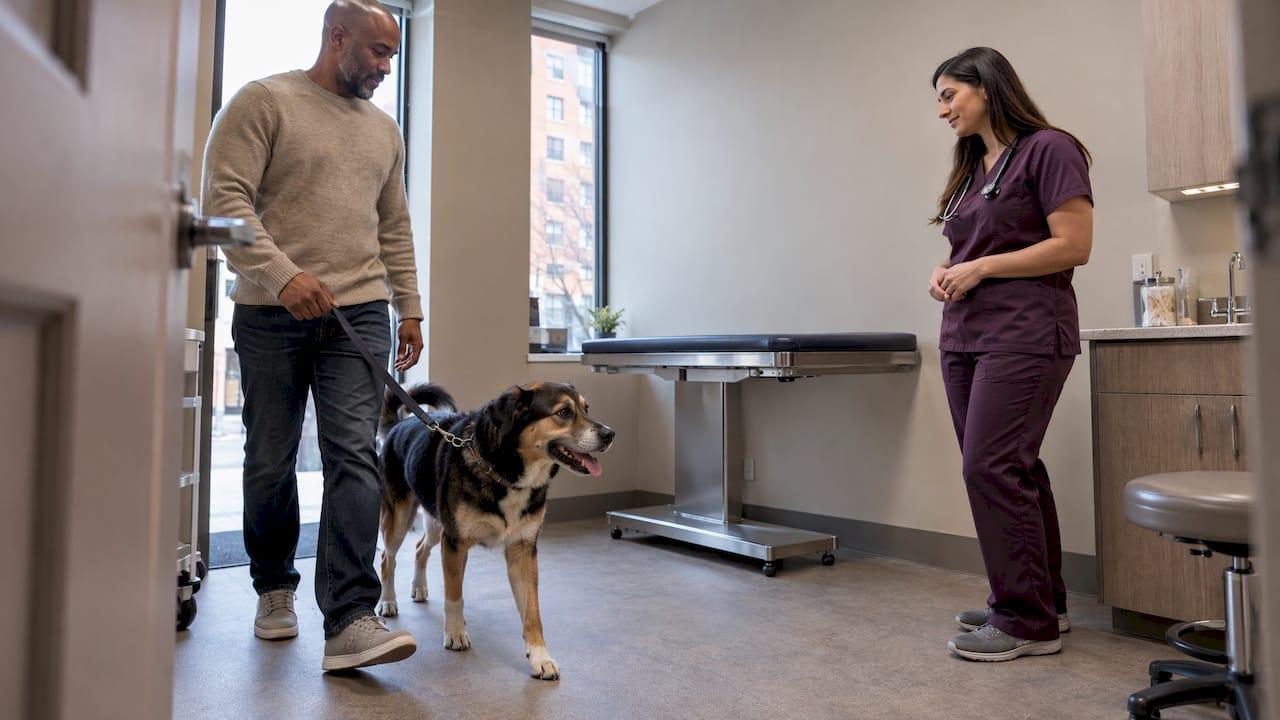
Desensitization means exposing your dog to the parts of a vet visit (touch, the carrier or car, the clinic itself) at a level so mild that fear never starts, and pairing each exposure with something your dog loves. Done in small steps over several weeks, it teaches a dog that the clinic predicts good things. It works best when your vet's team is part of the plan, because the clinic is the one piece you cannot rehearse alone. At City Animal Veterinary Center in Brooklyn, our approach is Fear Free, so the plan you practice at home is the same one we follow in the exam room.
TL;DR
- Desensitization works by starting below your dog's fear threshold, then raising difficulty only while your dog stays relaxed and keeps taking treats.
- Practice in three tracks: gentle handling at home, short happy car trips, and treat-only "happy visits" at the clinic with no needles.
- Plan for weeks, not days. A 2019 study of a four-week program found owners saw less fear, and its authors recommended longer, individualized programs.
- If your dog freezes, tries to escape or snaps, bring in your veterinarian early. Short-term calming support can be paired with training.
- Puppies are the easiest to prepare, and early practice matters because fear at the first exams can persist.
Table of Contents
- What desensitization and counterconditioning actually mean
- Is your dog afraid of the vet? Know the signs
- Step 1: Build comfort with handling at home
- Step 2: Make the carrier and the car boring or wonderful
- Step 3: Use happy visits to rewrite what the clinic means
- The treat rules that make or break it
- Starting early with a puppy
- How long it takes and what the research shows
- When your dog needs more than training
- Fear Free visits and home visits in Brooklyn
- FAQ
- Sources
What desensitization and counterconditioning actually mean
Two terms do the work here. Desensitization is gradual exposure to something at a low intensity that does not upset your dog. Counterconditioning changes how your dog feels about it by pairing it with a reward, usually food. Together, they are often shortened to DSCC. The idea is that the exam table or the stethoscope stops meaning "something bad is coming" and starts meaning "chicken is coming."
The order matters. Veterinary Practice News explains that DSCC must begin at an intensity that does not trigger a fear response, then increase gradually based on how comfortable the dog is. If you rush, you are not desensitizing. You are flooding.
If you want the longer version with a weekly schedule, our clinic-backed four-week desensitization and counterconditioning plan walks through it.
Is your dog afraid of the vet? Know the signs
Many dogs look "fine" when they are not. The American Animal Hospital Association (AAHA) behavior guidelines list the common signs of anxiety and distress in dogs:
- Panting, trembling, drooling
- Lip and nose licking, yawning
- Freezing or pacing
- Hiding or trying to escape
- Lowered body, tucked tail, dilated pupils
- Scanning the room, lifting a paw
- Grimacing or vocalizing
The American Veterinary Society of Animal Behavior (AVSAB) adds that dogs who go quiet and still are often experiencing fear even when they appear passive. A dog who stands motionless on the table is not necessarily a calm dog.
This is common. The same AVSAB statement reports that 38% of dog owners and 58% of cat caregivers say their animals hate going to the vet. It also matters medically: AAHA notes that stress can alter vital signs and test results, which can mask problems and complicate diagnosis.
Write down which signs you see and where they start: at the sight of the carrier, in the car, at the door, or on the table. That is your starting map, and it tells you which step below to begin with.
Step 1: Build comfort with handling at home
Most of a vet exam is touch: paws, ears, mouth, belly, a lifted tail, a restrained hold. So the most useful practice happens on your living room floor.
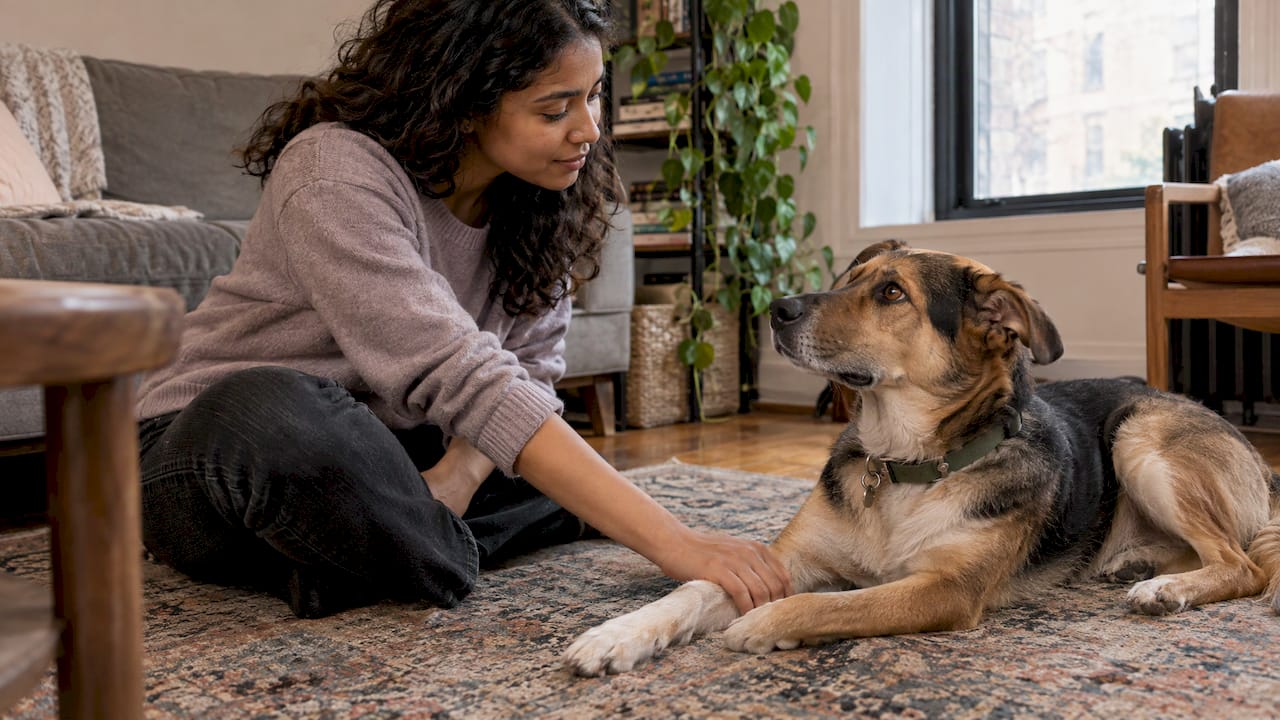
AAHA recommends lightly touching sensitive areas while rewarding your dog and gradually lengthening the hold. Its newer guidance suggests practicing calm handling of paws, ears, mouth and body for a few seconds at a time with treats.
For a dog who dislikes being touched, the American Kennel Club's trainer Stephanie Gibeault lays out a progression from feeding while touching, to touch then treat, to touching an ear for one second then treating, until the ear can be lifted and looked into. Here is how to apply it:
- Pick one body part your dog tolerates best. Start there, not with the worst one.
- Touch for one second, then give a treat. Repeat five times and stop.
- Only when your dog is relaxed, extend to two seconds, then a gentle hold, then a light squeeze.
- Move to the next body part. Keep sessions to a minute or two.
- Add exam-room skills: standing still, going to a mat, touching your hand with their nose. The AKC article suggests teaching these because they give your dog something to do on the table.
Where it goes wrong: pulling a paw away from a dog who is pulling back, or continuing because "he's almost there." Never force touch. If your dog's body stiffens or the treat is refused, you moved too fast. Go back one step.
If your dog is already wary of a muzzle, Cornell recommends a basket muzzle introduced with food. Our guide to muzzle training for vet visits covers the steps.
Step 2: Make the carrier and the car boring or wonderful
For many dogs the stress starts before the clinic. If the only time your dog rides in the car is for a vet appointment, the car becomes the first warning sign.
AAHA's advice is to take short, happy car trips that do not always end at the vet. Drive around the block and end at a park. Park, give a treat, go home. For small dogs in carriers, leave the carrier out in the house with treats inside so it becomes furniture rather than a trigger.
In Brooklyn, many of our clients do not own cars, so the rides are often a cab, a rideshare, a subway trip or a walk. The principle is the same: practice the exact mode of travel you will use, in short, rewarding pieces, with no appointment at the end. Our calm car rides guide goes through it step by step.
Step 3: Use happy visits to rewrite what the clinic means
A happy visit is a trip to the clinic on a day when nothing medical happens. Cornell's Riney Canine Health Center describes starting with treats in the car or parking lot, calling ahead so the clinic is not busy, and gradually working toward going inside. AVSAB recommends that clients be encouraged to bring pets for happy visits built on counterconditioning.
A good progression looks like this:
- Sidewalk or parking area: treats near the building, then leave.
- Doorway or lobby: a few treats and a greeting from staff, then leave.
- Exam room, no handling: sniffing, treats, maybe stepping on the scale.
- Gentle handling: the stethoscope or exam table with no procedure.
Today's Veterinary Nurse suggests keeping these visits to 5 to 10 minutes, ending before stress builds, and repeating them regularly, and pausing if you see lip licking, yawning or turning away. The point is to leave while your dog is still doing well, so the last memory is a good one.
AAHA also advises avoiding busy waiting rooms. Calling ahead to arrange a quiet time or a direct-to-room entry makes a real difference, and it is something our team can plan with you.
The treat rules that make or break it
Treats are the currency, but they only work under the right conditions.
- Use high-value food. Cornell suggests small, soft treats that can be broken into pieces, plus a frozen treat dispenser or lick mat with spreadable food for distraction.
- Reserve the best treat for vet practice. Special food that appears only for vet-related practice makes the association stronger.
- Time the meal. AAHA suggests skipping breakfast on the day of a visit so treats are more motivating.
- Watch for refusal. Cornell notes that if your dog stops eating, stress may be too high and the plan needs adjusting.
That last point is the one owners miss. Veterinary Practice News describes how at high stress levels offering food can ruin it: the fear can "poison the reinforcer," so the treat itself starts predicting something scary. A refused treat is information, not stubbornness. Back up to an easier step.
Starting early with a puppy
Puppies are the best candidates because their fear is not yet established. AAHA's guidelines cite studies in which 10% of puppies that were fearful during an exam at 8 weeks were still fearful at 18 months, and state that dogs do not outgrow pathologic fear.
Veterinary Practice News describes "Victory Visits" during the critical socialization window of 8 to 16 weeks: the puppy comes in for treats from staff, to sniff and climb on the scale, or for a tour, at its own pace. The same AAHA guidelines say there is no medical reason to delay puppy classes or social exposure until vaccinations are complete as long as contact with sick animals is prevented and hygiene is practiced. Your vet can tell you which situations are safe for your puppy's vaccine stage.
One warning from the same guidelines: forcing a fearful puppy into social exposure makes fear worse, and exposure without watching the puppy's response produces sensitization instead of desensitization. Let the puppy choose to approach.
For a week-by-week approach, see our puppy socialization checklist and our guide to your puppy or kitten's first wellness exams.
How long it takes and what the research shows
Be realistic about the timeline. A peer-reviewed 2019 study tested a standardized four-week desensitization and counterconditioning program with 15 trained dogs and 22 controls. 86.7% of owners reported reduced fear, and the authors recommended longer, more intensive and individualized programs. In that study, 44% of owners did not complete the training as instructed.
Two lessons follow. First, a plan fitted to your dog beats a generic one. Second, consistency is the variable you control: short daily sessions beat a long weekend push. Veterinary Practice News is blunt that DSCC takes time and is unlikely to produce immediate results.
A practical rhythm:
| Weeks | Focus |
|---|---|
| 1 | Handling basics at home, short car or carrier sessions |
| 2 | Longer holds, mat and standing cues, parking-lot happy visit |
| 3 | Lobby or exam-room happy visit, stethoscope and table introduction |
| 4 and on | Repeat weekly, add new body parts, keep ending on a win |
Treat this as a starting frame and extend any week your dog needs.
When your dog needs more than training
Some dogs are too afraid for practice alone to get traction. AAHA advises talking with a veterinarian if a dog shows intense fear around visits, such as freezing, vocalizing, trying to escape or becoming aggressive. The vet may recommend short-term calming medications or supplements before appointments, combined with positive handling and gradual exposure.
There is evidence behind this. A 2023 JAVMA clinical trial of 45 anxious or aggressive dogs found that a client-given pre-visit medication protocol significantly lowered stress scores, and complete examinations became possible in 5 of 8 dogs previously too unsafe to examine. The authors position medication as a bridge while the slower training work builds. Doses and drug choice depend on your dog's health, age and other medications, so they are always set by your veterinarian. Never give your dog a medication, human or veterinary, on your own for this purpose.
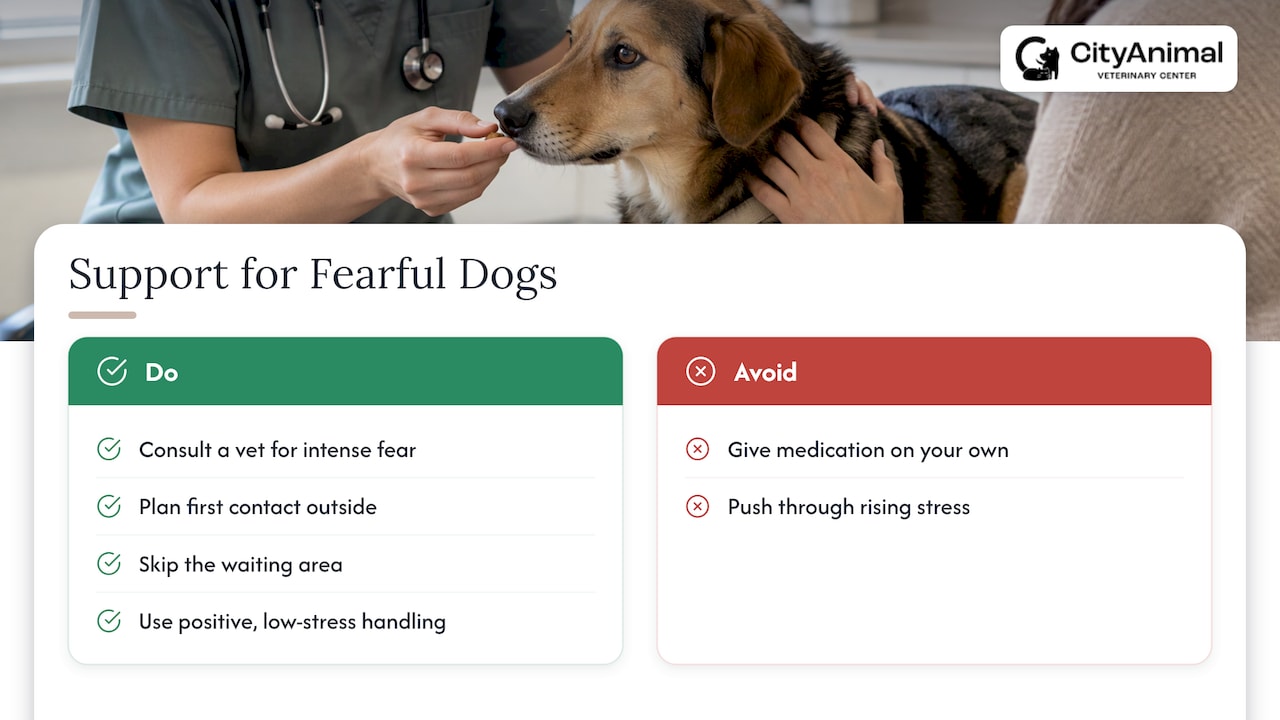
AAHA's life stage guidelines also describe what a good clinic does for known fearful dogs: plan first contact outside the building, skip the waiting area, use low-stress handling with positive reinforcement, and if stress builds, send the dog home and reschedule with pre-visit support. That is a normal, good outcome, not a failure.
If your dog growls, snaps or lunges, stop practicing alone and read our guide on stopping rehearsal in aggressive dogs, then book a behavior consultation. AVSAB notes that aggression is almost always rooted in fear.
Our view: the clinic is half of desensitization
Owners often come to us after weeks of faithful home practice, and the dog still falls apart at the door. That is rarely a training failure. Home practice builds your dog's skills, but the clinic has to meet your dog halfway.
That is why we are Fear Free. Our team works to reduce stress at every point of the visit, so the lessons you teach at home are not undone in the exam room. For dogs and cats who struggle to travel at all, our home visits let your pet be examined in familiar surroundings, and for dogs with deeper behavior concerns we offer behavior management alongside holistic options such as acupuncture and pain management.
AVSAB says it only takes one negative experience to trigger fear that generalizes to future visits. We take that seriously: if your dog is not ready for a procedure, we would rather pause and rebuild than push through.
CAVC
Fear Free visits and home visits in Brooklyn
If your dog is anxious, the easiest way to protect your training is to pair it with a clinic built around low-stress care. City Animal Veterinary Center is a Fear Free practice in Brooklyn, and our team can talk through your dog's triggers before you ever book an exam. Many owners start with a wellness exam, where we can build a plan around your dog's signs and what you have already practiced.
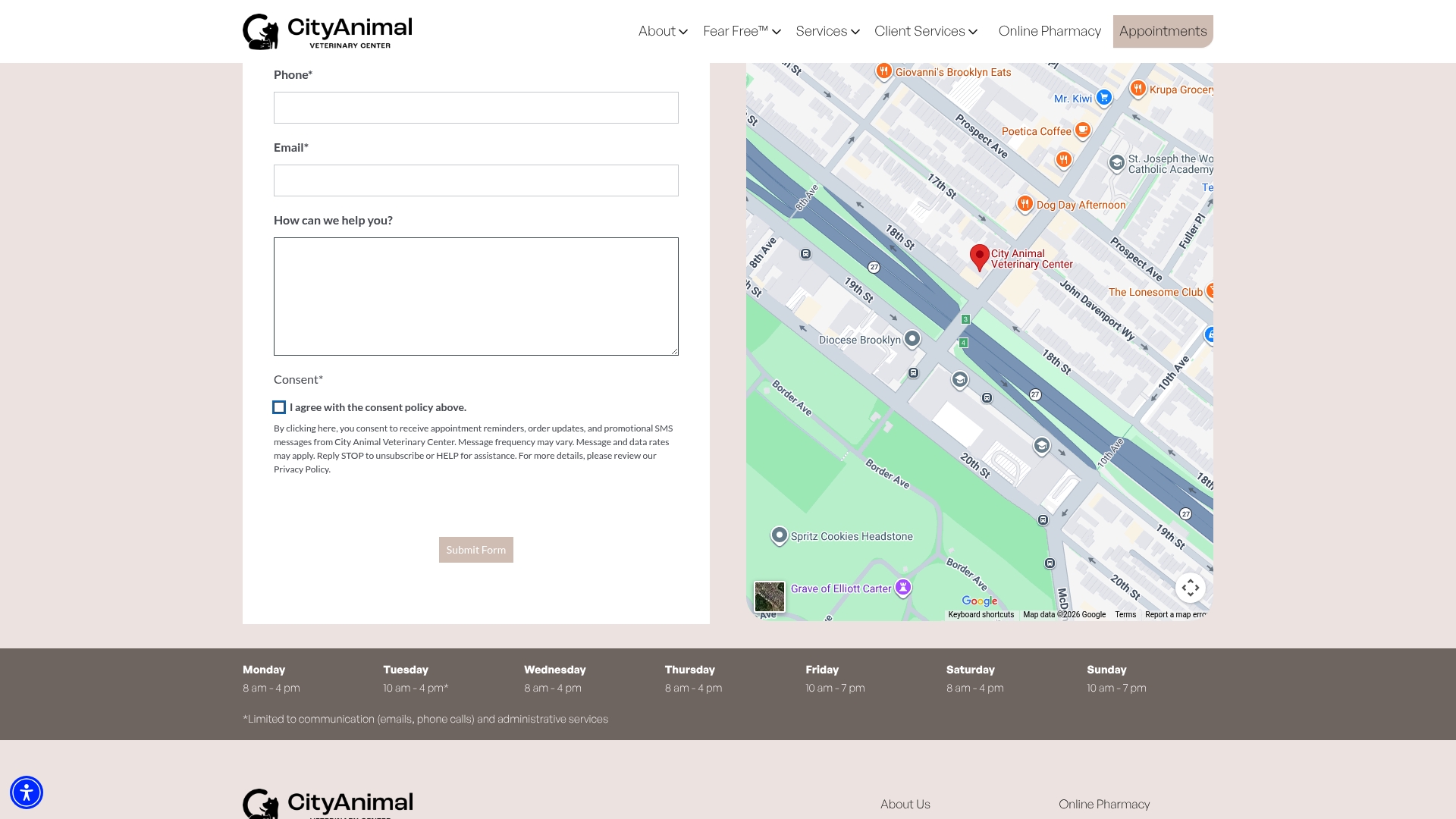
If the trip itself is the hurdle, or your schedule is packed, our home visit and house call service brings the exam to your living room. Our home visit preparation checklist shows how to set up. For a dog who needs more specific help, our behavior management and holistic services are another route, and you can reach us through cityanimalvet.com.
FAQ
How long does it take to desensitize a dog to the vet?
Expect weeks to months, depending on how deep the fear runs. A four-week standardized program in a 2019 study reduced fear for most owners, but its authors recommended longer, individualized programs. Progress is judged by your dog's body language and appetite, not the calendar.
Can I start desensitization if my dog already panics at the clinic?
Yes, but start further back than you think: treats in the car, then the parking area, before the door. If your dog refuses food at any step, you are past the fear threshold, so go back one step. Tell your vet about the panic so they can plan quiet entry and, if appropriate, pre-visit support.
What treats work best for vet training?
Small, soft, high-value pieces that your dog does not get at other times. A lick mat with a spreadable treat can keep your dog occupied during handling. Skipping breakfast before a visit makes food more motivating.
Does this work for cats too?
The principles of gradual exposure, rewards and a carrier that is a safe place carry over, but cats have their own signals and needs. We cover them in our cat vet anxiety guide.
Should my dog take medication before the vet?
Only if your veterinarian prescribes it for your dog. Pre-visit medication can lower stress for dogs who are very fearful, and it is used together with training, not instead of it. The right drug and dose depend on your dog's health and history.
Sources
- Effect of a Standardized Four-Week Desensitization and Counter-Conditioning Training Program (PMC)
- AAHA: How can my pet have stress-free veterinary visits?
- AAHA: Preparing your pet for a successful veterinary visit
- AAHA 2015 Canine and Feline Behavior Management Guidelines
- AAHA 2019 Canine Life Stage Guidelines
- AVSAB Position Statement on Positive Veterinary Care
- Cornell Riney Canine Health Center: How to make veterinary visits less stressful for dogs
- AKC: How to Make Vet Visits Stress-Free and Pleasant for Your Dog
- Today's Veterinary Nurse: Making Veterinary Clinics a Positive Experience for Dogs
- Veterinary Practice News: Lower-stress care for dogs starts at home
- JAVMA 2023: Gabapentin, melatonin, and acepromazine combination prior to veterinary visits