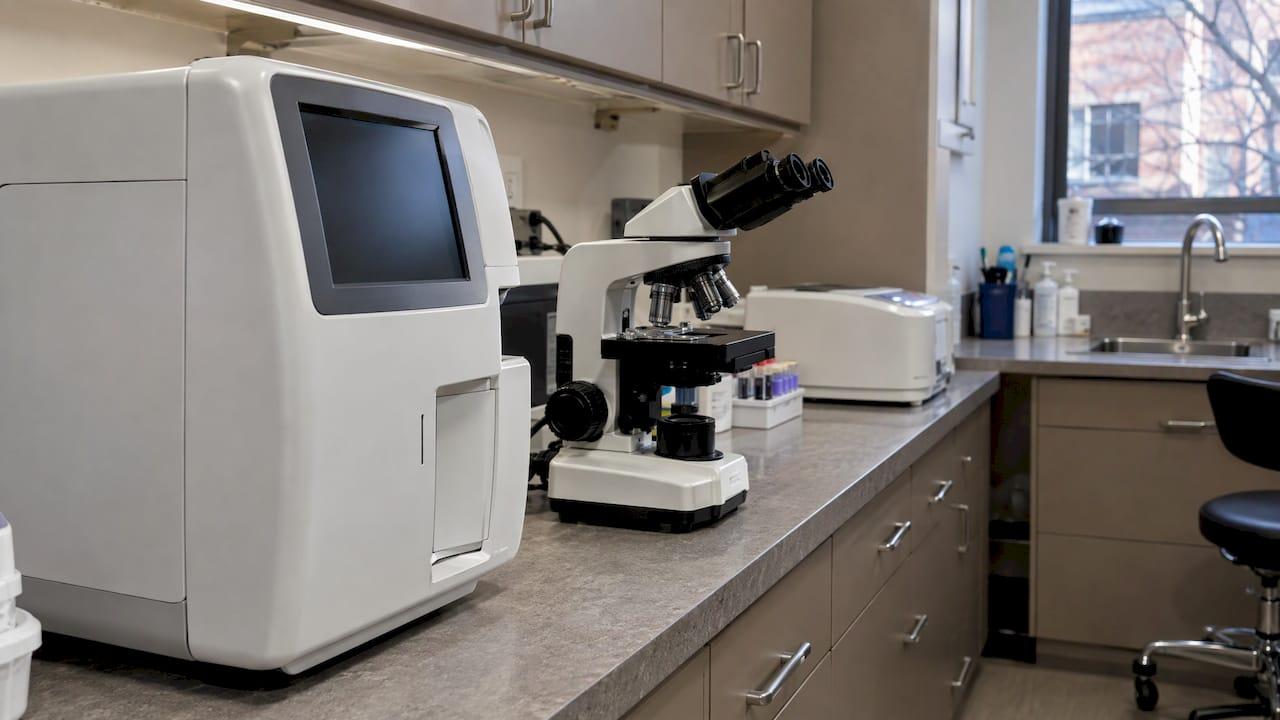
An in-house lab means your vet runs certain tests inside the clinic, so blood, urine and stool samples are analyzed in the building instead of being packaged and shipped away. For many routine questions, that turns a days-long wait into answers during the same visit. At City Animal Veterinary Center in Brooklyn, our in-house laboratory sits alongside Fear Free™ visits and house calls, so one trip, or one visit at your door, can answer more of your questions.
TL;DR
- An in-house lab is a laboratory inside the veterinary practice where the team collects and tests samples on-site, usually with a machine that processes blood in well under an hour.
- Typical in-house work covers blood counts, chemistry panels, urinalysis, fecal exams and cytology. The exact menu differs from clinic to clinic.
- Faster answers mean fewer return trips, quicker decisions when a pet is sick, and less stress for animals who dislike the clinic.
- Some specialized tests are sent to an outside reference laboratory. That is a normal part of good diagnostics, not a sign that anything is wrong.
- You can help by bringing fresh urine or stool samples and by following fasting instructions when your vet gives them.
Table of Contents
- What an in-house lab actually is
- Which tests can run in the building
- Why same-visit answers matter to you and your pet
- How long do results take?
- When a sample goes to an outside lab
- Testing with judgment, not by default
- How to prepare so the results are reliable
- Questions to ask any practice about its lab
- Where we fit: lab work with a calmer visit
- Our perspective
- FAQ
- Sources
What an in-house lab actually is
The phrase on a vet's website can sound vague, so here is the plain meaning. The practice has a laboratory space within its building, often a dedicated room or workstation, equipped with machines that analyze blood, plus microscopes for looking at cells and parasites. Vet Help Direct describes it as a setup that allows blood tests, microscopy, fecal analysis and urinalysis on the premises, with machines usually processing a sample in under 15 minutes.
The Merck Veterinary Manual adds that many clinics run basic laboratory tests on-site, and that owners can sometimes collect stool or urine samples at home and bring them in.
Without that lab, a blood sample has to be packaged and sent by post or courier to an external laboratory. The results are analyzed there and sent back before the practice can call you, according to the same Vet Help Direct explainer. An in-house lab removes that travel time from the process.

Which tests can run in the building
The menu depends on the clinic and its equipment. An open veterinary terminology textbook from Open Education Alberta lists the common in-house categories:
- Urinalysis: urine concentration, cells, crystals, bacteria, pH and glucose.
- Fecal tests: a flotation and direct smear to look for intestinal parasites.
- Blood work: packed cell volume and total protein, a complete blood count (CBC), a chemistry panel and a look at cell shape.
- Cytology: cells from ear swabs, fine needle aspirates and skin scrapings, examined under the microscope.
What a chemistry panel tells your vet
A chemistry panel measures several chemicals in the blood at once. The Merck Veterinary Manual says it gives clues about hydration, inflammation, kidney and liver function, and blood sugar control. A creatinine value out of range can point to kidney disease, a blocked urinary tract or a ruptured bladder, and an abnormal glucose can mean diabetes or simple stress. That is why vets read the numbers alongside your pet's exam, history and symptoms, never alone.
If you want to see how the numbers are read, our guide to dog blood work explained walks through a typical report line by line.
Urine, stool and skin: the quiet workhorses
Blood gets the attention, but many everyday answers come from other samples:
- A urine sample can show concentration, crystals and signs of infection. See urinalysis in dogs and urinalysis for cats for what each result means and how to collect the sample.
- A stool sample screens for parasites. Our guides to fecal tests for dogs and collecting stool samples explain what to bring and how fresh it should be.
- Skin and ear cells examined under the microscope help explain itching and infections. Read more in our skin cytology guide.
Why same-visit answers matter to you and your pet
Faster decisions when something is wrong
When a pet is vomiting, lethargic or off its food, hours count. The Merck Veterinary Manual's overview of private practice laboratories says in-house testing is often desirable because commercial lab reporting intervals can be a problem at nights and on holidays. Having the analyzers in the building means your vet can look at the numbers while your pet is still in front of them, then adjust the treatment plan right away.
Fewer trips for busy owners
If you juggle work, kids or a long commute, a second appointment just to hear lab results is a real cost in time. With in-house testing, many results can be reviewed in the same visit, so the plan, the prescriptions and the next steps are settled in one conversation instead of a string of phone calls.
Less stress for anxious pets
For a cat that hides in the carrier or a dog that trembles in the waiting room, every extra visit is another round of fear. Fewer visits mean fewer chances for that fear to build. This is where the lab and our approach work together: we are a Fear Free practice, and getting answers in one calm visit fits that goal.
How long do results take?
Timing depends on the test. Most blood analyzers finish in minutes, but the rest of the process adds time: the blood has to be drawn, separated and loaded, and other tests such as stool flotation involve hands-on technician work. Vet Help Direct notes that machines usually process a sample in less than 15 minutes, although queues can add time. Plan on getting results during the appointment or the same day for common tests, and expect a call for anything that needs extra review.
Tests that look for antibodies or confirm an infection can take longer. DVM360's guide to diagnosing infectious disease notes that some titer tests are run in-house but most are submitted to reference laboratories, where results take a few days. It also stresses that a high antibody level alone does not prove disease, so your vet may pair it with a second test to confirm.

When a sample goes to an outside lab
In-house testing and reference laboratories work as a team. The Merck Veterinary Manual explains that many tests require specialized equipment or trained staff, so vets send some samples out, for example when they want a pathologist to review abnormal blood cells or need advanced tests such as spotting blood parasites on a smear. The Open Education Alberta textbook likewise says more specific tests are generally sent to an external laboratory.
So the strongest setup is a clinic that runs the everyday tests on-site and chooses the right outside lab for the specialized ones. That gives you speed where speed helps and depth where depth is needed.
Testing with judgment, not by default
More tests are not always better. The AVMA's article on choosing tests reports that veterinarians weigh clinical usefulness, accuracy, necessity, availability and practicality. One veterinarian quoted there says a test should lead to an action that benefits the patient. The same article warns that testing too broadly can cause worry over small changes that sit within the normal range.
A good in-house lab supports that judgment: your vet orders what your pet's signs and history call for, reads the results in context, and explains what they mean for your animal.
How to prepare so the results are reliable
Sample quality shapes result quality. The Open Education Alberta textbook gives these handling rules:
- Urine: analyze within 30 minutes of collection, or refrigerate and test within 12 hours.
- Blood: run promptly, or let it clot and refrigerate if not tested right away. Your vet handles this, but follow any fasting instructions you are given beforehand.
- Stool: test immediately or refrigerate to limit bacterial growth.
A few practical habits help:
- Collect the sample as close to your appointment time as you can, and tell us when you collected it.
- Use a clean, sealed container and label it with your pet's name.
- If your pet has diarrhea that comes and goes, ask your vet whether several samples over a few days are useful. Our guide to giardia testing in dogs explains why.
- For a urinary infection workup, see urine culture in dogs to learn how a culture differs from a basic urinalysis.
If your pet is not feeling well, never wait for a lab appointment. Call your vet or an emergency clinic right away for trouble breathing, repeated vomiting, a swollen belly, inability to urinate, collapse or seizures.
Questions to ask any practice about its lab
When you are choosing a neighborhood vet, a few plain questions tell you a lot:
- Which tests are run on-site, and which are sent out?
- Will results be reviewed during my visit, or will someone call me?
- Can I bring a urine or stool sample ahead of time?
- Can the team collect samples in a low-stress way for my nervous pet?
- Is lab work available when my pet is sick and needs a same-day visit?
We are happy to answer each of these about our own practice. Call us and ask.
Where we fit: lab work with a calmer visit
At City Animal Veterinary Center, the in-house laboratory is one part of a practice built around calm, compassionate care. Our services also include wellness exams, urgent care, diagnostic imaging with digital X-rays and ultrasound, and house calls for owners who find travel hard. Fear Free™ handling is how we approach every visit, from the first greeting to sample collection.
If your pet is due for a checkup, has a symptom you want looked at, or needs lab work before a procedure, book a wellness exam or ask about our home visit service. Learn more about our in-house laboratory on its service page.
Our perspective
We built our care around a simple idea: the less a pet has to go through to get an answer, the better the visit goes for everyone.
An in-house laboratory is part of that. When a sample is collected in a calm setting and analyzed in the same building, we can talk with you about what we are seeing while your pet is still with us. That means a clearer plan, fewer follow-up calls and fewer trips.
Lab work does not stand alone. We read results together with a thorough exam, your pet's history, and imaging such as digital X-rays and ultrasound when it helps. For senior pets, new puppies and kittens, and pets with skin, dental or pain concerns, that full picture is what turns a number on a page into good care.
Our Fear Free approach, and our house call service for clients who cannot easily travel, exist for the same reason as our lab: to make good veterinary medicine easier for you and gentler for your pet.
CAVC
FAQ
What does "in-house lab" mean at a vet clinic?
It means the clinic has its own laboratory and runs certain tests on-site rather than sending every sample away. Typical examples are blood counts, chemistry panels, urinalysis and fecal exams. Which tests are available depends on the clinic's equipment.
Will I get my pet's results during the visit?
Often for common tests, yes, because many blood analyzers finish in minutes. Results can also arrive later the same day by phone, particularly when a test needs more hands-on work or review. Ask your vet at check-in when to expect them.
Can I bring a stool or urine sample from home?
Yes, in many cases. The Merck Veterinary Manual notes that owners can sometimes collect stool or urine samples and bring them in. Keep the sample fresh and sealed, note when you collected it, and check with your clinic first so it brings the right container and instructions.
Do all tests run in the clinic?
No. Some specialized tests, such as certain infectious disease confirmations or pathologist review, are sent to an outside reference laboratory. Your vet decides which route fits your pet's situation and will tell you when to expect those results.
Does an in-house lab help an anxious pet?
It can. When answers arrive during one visit, there are fewer return trips and less repeated stress. Combined with gentle, Fear Free handling at sample collection, it makes the experience easier for both pet and owner.
Sources
- Common Laboratory Tests in Veterinary Medicine, Merck Veterinary Manual
- Overview of Diagnostic Procedures for the Private Practice Laboratory, Merck Veterinary Manual
- What does in-house lab mean on a vet's website, Vet Help Direct
- Laboratory Terminology, Introduction to Veterinary Medical Terminology
- Striking the right balance when choosing tests, AVMA
- Diagnosing infectious disease, DVM360